



Notes from the Nominators
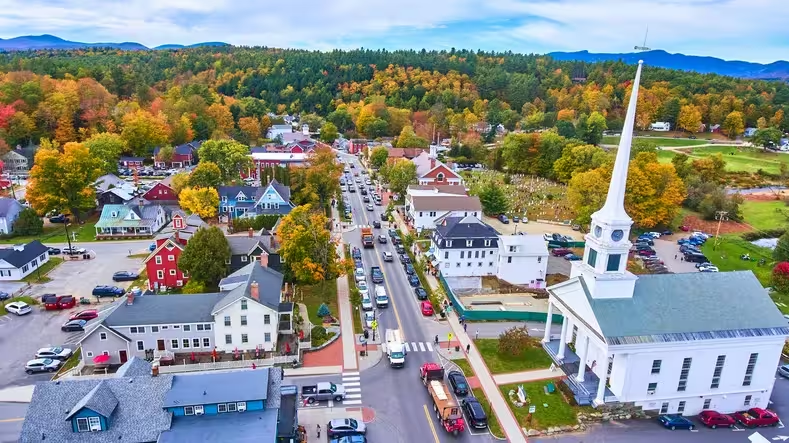
Stowe is one of those rare places where natural beauty and authentic community still coexist. Most people know the name Stowe. Even if they have never been there, they picture it: a quintessential New England village with a white church steeple, historic Main Street, covered bridges and a mountain backdrop that changes dramatically with the seasons. That image is real.
Nestled at the base of Mount Mansfield, Vermont’s highest peak, Stowe is home to just over 5,000 year-round residents. Yet in peak seasons, tens of thousands of visitors move through our valley each week. On busy winter and fall weekends, visitors can outnumber locals many times over. It is a true four-season destination: world-class skiing and riding in winter, hiking and mountain biking in summer, iconic foliage in fall and a quieter spring that locals cherish.
But what truly defines Stowe is not the visitor volume; it is the people who live here full time. Behind the postcard is a deeply engaged resident community: small-business owners, teachers, tradespeople, hospitality workers, artists, entrepreneurs and families who show up for Town Meeting, serve on volunteer boards, coach youth sports and shape the future of the town.
Civic participation remains strong. People care about land conservation, historic preservation, education and maintaining a vibrant village center. Stowe contributes significantly to Vermont’s tourism economy, generating some of the highest lodging, meals and property tax revenues in the state. Yet despite its global recognition, it remains rooted in small-town traditions and local governance.
Stowe is not simply a resort. It is a living community balancing international appeal with year-round life, evolving thoughtfully while working to preserve the character that makes it special. It is beautiful, yes. But more importantly, it is lived in.
In Stowe, neighbors did not just talk about the housing crisis — we moved from contention to collaboration. In 2024, after a contentious public vote directing the town to monitor short-term rentals and better understand the local housing crisis, the Selectboard formally established a Housing Task Force. The group builds on years of groundwork by the Planning Commission and engaged residents, but its creation marked an important shift: housing was no longer a side conversation. Instead, it became a central civic priority.
The Housing Task Force was created by the Selectboard and is staffed by the Town of Stowe. The committee brings together experts in housing, financing, real estate, resorts and nonprofits that all call Stowe home.
The urgency was clear. Over two decades, Stowe’s homestead share declined from roughly 38% to 27% of taxable parcels. The median house cost, at $970,000, was out of reach for most residents. At the same time, more than 1,200 short-term rental units were registered in a town of just over 5,000 year-round residents, while long-term rental vacancy rates hovered near zero. At the same time, our infrastructure (roads, water, sewer and schools) was crumbling without sufficient funding. The data pointed to structural imbalance, not just anecdotal frustration.
Since its formation, the Task Force has helped commission a Housing Needs Assessment and evaluated available data to assess the housing crisis and suggest initiatives. The work has not been easy (public debate has been real), but the process is transparent and data-driven. Neighbors sit alongside technical staff. Draft policies are revised publicly. Decisions are debated openly. However, well-funded opposition, including short-term rental advocates, has created significant misinformation and pushback.
In a four-season resort town shaped by outside demand, Stowe is choosing long-term structural change over short-term reaction. That collaboration, born from tension but grounded in partnership, is how we are working to remain a resilient, functioning town.
For years, the signals were there. Stowe’s overall population had not dramatically collapsed, but the share of full-time residents was steadily declining while home prices soared. The population was aging. It became harder to see young adults in the 20–35 range putting down roots. We were building homes and attracting huge investment, but increasingly not residents.
School enrollment began to shrink. Local businesses struggled to hire. Volunteer boards had fewer year-round participants. The civic and economic ecosystem was thinning in subtle but measurable ways.
Then COVID-19 accelerated everything. Remote wealth flowed in. Housing prices surged. Short-term rental growth intensified. Roads became congested at peak periods. Water and sewer systems approached capacity. Businesses reduced hours, not for lack of customers but for lack of staff. The imbalance between the visitor economy and resident community became visible in daily life.
The breaking point came when residents conducted a town-wide vote to establish a short-term rental registry so we could finally measure what was happening. The vote required in-person participation. Nearly 1,000 residents filled a hot high school gymnasium (standing room only) and the measure passed.
The registry gave us baseline data. The town then commissioned a comprehensive Housing Needs Assessment, which confirmed long-term rental vacancy near zero and documented the growing workforce housing gap. It moved the conversation from anecdote to evidence.
We did not wait for outside funding. Using local authority and municipal tools already in place, Stowe began monitoring short-term rentals, evaluating zoning reforms and initiating regulatory change. The work continues. But that packed gym, and the decision to follow it with real data, marked a turning point. Stowe chose to confront imbalance directly rather than continue drifting away from being a functioning, year-round town.
What keeps me working to make Stowe stronger is deeply personal, since I grew up here. I left, built a career internationally and, a decade ago, I was fortunate enough to return. Stowe once offered that pathway: grow up here, leave to build something and realistically come home. That circular promise felt like part of the American dream.
Today, that pathway does not exist or is narrowing — not just in Stowe, but across the country. The median home price in Stowe is now roughly $970,000. At current interest rates, that price is out of reach not only for service workers but for teachers, nurses and tradespeople — even many of the highest local earners. Young adults in their 20s and 30s who grew up here often cannot find a long-term rental, let alone buy their first home. I would not be able to return home today.
But this is not only about one resort town. Across America, high-amenity communities, and increasingly ordinary ones, are being absorbed into a global housing marketplace. Homes function less as places to live and more as appreciating assets. Short-term rentals and second-home ownership accelerate that shift. Wealth concentrates. Entry-level ownership disappears. The middle class thins.
On paper, places look prosperous: rising property values, strong tourism, full restaurants. But if housing detaches from local wages, that prosperity becomes fragile. Schools shrink. Civic participation declines. Communities hollow out.
Stowe is simply a visible example of a broader systemic pattern: the erosion of broad-based ownership that once defined American stability. The dream was never about luxury. It was about attainable belonging.
Strong Towns argues that resilience comes from local stewardship and productive, community-serving land use — not speculative escalation. If towns cannot house their teachers, tradespeople, young families and essential workers, they risk becoming beautiful but brittle.
What inspires me is that we still have local agency. If we rebalance policy toward housing opportunity and year-round residency, we are not just helping Stowe: we are pushing back, in a small way, against a national drift away from broad-based prosperity.
I want Stowe to remain a living town. And I want the next generation, here and elsewhere, to still have a viable path home. That is bigger than one community.
